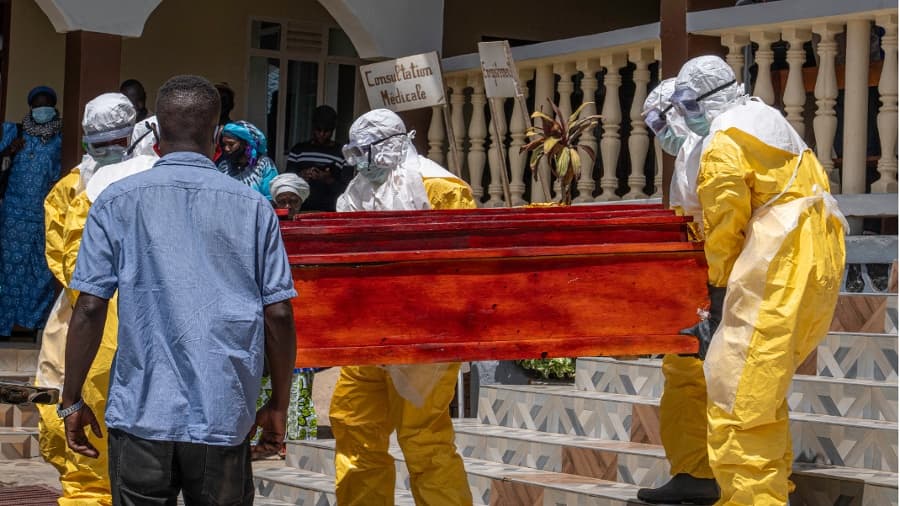
Deadly Bundibugyo Ebola Outbreak in Congo Becomes Third Largest in History
According to the United Nations, the Ebola outbreak of the Bundibugyo strain in the Democratic Republic of the Congo has lasted only a few weeks, yet the total number of infections has already become the third largest Ebola outbreak in history. To date, World Health Organization (WHO) statistics report more than 900 suspected cases and over 220 suspected deaths. However, many public health experts agree that the actual scale of infection is likely far larger.
WHO Director-General Tedros Adhanom Ghebreyesus has warned that the speed of viral spread is still outpacing containment efforts, and he will personally travel to the DRC to assess the situation on the ground, The Guardian reported. Commentator Tang Hao also warned that the upcoming World Cup could become the greatest risk point for breaching U.S. border defenses.
A neglected deadly strain
The culprit behind this outbreak is the Bundibugyo virus—a very rare strain of Ebola. It is named after the mountainous region of western Uganda, where it first appeared in 2007, and has only caused two outbreaks prior to this one.
Because it is so rare, local laboratories did not even include it in their standard Ebola screening protocols, resulting in significant delays in identification and allowing the virus to spread silently.
Commentator Tang Hao noted that the Bundibugyo strain has a fatality rate of about 40 percent, far higher than COVID-19’s estimated 1.08 percent fatality rate. More concerning, there is currently no approved vaccine or effective treatment for this strain. This means that once infected, patients largely depend on their own immune systems to fight for survival.
SIGN UP FOR OUR FREE NEWSLETTER
You are now signed up for our newsletter
Check your email to complete sign up
The virus spreads through contact with bodily fluids such as blood, sweat, saliva, excreta, and vomit of infected individuals, rather than through airborne transmission like COVID-19. While this may appear to reduce transmission risk, Tang Hao emphasized that it actually makes containment more difficult—healthcare workers, mortuary staff, and close contacts face extremely high exposure risk. Even after death, bodies remain highly infectious.
In many local communities, traditional burial practices involve touching and washing the bodies of the deceased and gathering relatives for collective mourning rituals, creating what he described as a “cultural breach” in epidemic control.
According to the Associated Press, on May 21, a shocking incident occurred in the mining town of Rwampara in eastern Congo: after an Ebola patient died, relatives stormed a medical facility and set the entire building on fire—reportedly because the hospital refused to release the body for traditional burial rites.
Tang Hao described the incident as a “war between civilizations,” highlighting the deep conflict between modern medical protocols and local cultural practices, and suggesting that epidemic control faces challenges far beyond the virus itself.
Multiple causes of uncontrolled spread
Ituri Province, the epicenter, is located in northeastern DRC, bordering Uganda and South Sudan, and has long been affected by armed conflict. Around 2 million people are displaced, tens of millions face severe food shortages, and violence has escalated over the past two months, severely hindering the delivery of aid.
Compounding the problem is deep public distrust toward the government and external organizations, which has directly obstructed key measures such as contact tracing, quarantine, and vaccine distribution.
Of particular concern to the international health community is a new development: confirmed deaths have also been reported in South Kivu Province in southeastern DRC, Reuters reported. This location is hundreds of kilometers from the original outbreak zone, indicating that the virus has already made a cross-regional “jump.”
South Kivu is currently controlled by the M23 rebel group, which has no experience handling large-scale outbreaks and lacks adequate medical and containment capacity, making uncontrolled spread highly likely.
Tang Hao also cited comments from former U.S. CDC Director and virologist Robert Redfield.
In an interview with NewsNation, Redfield noted that Ebola outbreaks in Congo were typically identified and contained quickly when only 5–10 cases were present. In contrast, the current outbreak was not detected until it had already reached hundreds of cases, a delay he finds deeply alarming.
Redfield warned that the outbreak could evolve into a cross-border global pandemic and identified Tanzania, South Sudan, and Rwanda as high-risk spillover countries.
The US border defense under pressure
Facing the risk of international spread, the United States quickly upgraded its entry controls.
On May 21, the U.S. State Department issued new entry restrictions: all foreign nationals who had visited the DRC, Uganda, or South Sudan in the past three weeks were banned from entering the United States. U.S. citizens and green card holders returning from these regions must be routed through Washington Dulles International Airport for enhanced Ebola screening before entry is permitted.
Why was Dulles chosen as the sole Ebola checkpoint? According to Tang Hao, the logic includes several factors: it is a major entry hub for African travelers transiting through Europe; it has full CDC, customs, quarantine, and medical assessment capabilities; and it is located near the National Institutes of Health (NIH) and hospitals equipped to handle high-risk infectious diseases.
This approach follows lessons from the 2014 West Africa Ebola outbreak, when the U.S. designated five airports for screening incoming travelers from affected regions, with Dulles handling about 22 percent of those arrivals. This time, the system has been narrowed to a single entry point to improve efficiency and reduce leakage risk.
However, the defense was tested almost immediately. According to the New York Times, on May 21, Air France Flight 378 from Paris to Detroit was forced to divert after U.S. authorities discovered that a passenger onboard had recently traveled from Congo, in violation of newly issued entry rules. The aircraft was rerouted to Montreal, more than 800 kilometers from its intended destination.
Air France claimed it was an operational error that allowed the passenger to board, but details remain unclear.
Tang Hao interpreted the incident as having three implications: first, the U.S. is pushing its defense line outward to fight the epidemic beyond its borders; second, national security and public health have become politically sensitive ahead of the upcoming midterm elections; and third—most importantly—a major global sporting event is approaching.
The World Cup: a major transmission risk
On June 11, the FIFA World Cup will begin in North America. More than 200 top players from 48 countries will participate, and over 100 million fans are expected to travel to host cities including New York, Los Angeles, and Dallas—locations where comprehensive Ebola screening coverage is difficult.
Tang Hao warned that the World Cup could become the greatest vulnerability in U.S. defenses against Ebola. Large-scale international movement significantly increases the chance of screening failures. Even a single asymptomatic or incubating infected individual could trigger an untraceable chain of transmission.
Although Congo has canceled its pre-World Cup training camp to reduce infection risk, its national team still plans to travel to the U.S. for competition, creating contradictory signals that complicate prevention efforts.
The virus is far from contained: urgent global action needed
The symptoms of Ebola further complicate containment. Early-stage infection presents with fever, headache, fatigue, muscle pain, and sore throat—nearly indistinguishable from influenza. Only after four to five days do more severe symptoms appear, including diarrhea, vomiting, rash, and internal or external bleeding, potentially leading to liver and kidney failure.
During the incubation period, patients may already be capable of transmitting the virus, making early detection one of the most difficult challenges in containment.
Tang Hao also pointed out that growing economic and personnel exchanges between China and Africa, combined with the difficulty of detecting the Bundibugyo strain through conventional testing, pose a hidden risk to China and the broader Asia-Pacific region.
Overall, the world is currently in a high-risk race against time. Vaccines cannot be deployed quickly, local conditions in outbreak regions remain unstable, and global movement is accelerating due to events like the World Cup. Under these combined pressures, WHO Director-General Tedros’s warning carries increasing weight:
“We are urgently scaling up operations, but at the moment the epidemic is outpacing us.”