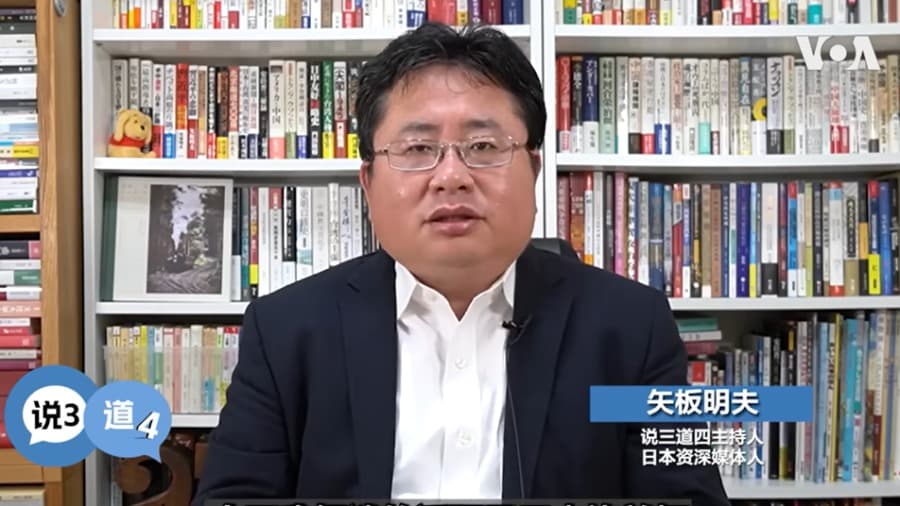
Taiwan Investigates Attack on Akio Yaita as Possible Case of Transnational Repression
Officials are investigating whether the July 6 assault on Japanese-born journalist and think tank director Akio Yaita in Taiwan was an isolated attack or part of a broader pattern of cross-border repression, after police arrested a mainland Chinese national allegedly attempting to leave the island hours after the incident.
Yaita, executive director of the Taipei-based Indo-Pacific Strategic Think Tank, was assaulted after delivering a speech in Taichung on July 6. Police later arrested a 33-year-old Chinese national surnamed Liao at Taichung International Airport before he could board a flight to Busan, South Korea.
Taiwan’s Ministry of Foreign Affairs (MOFA) strongly condemned the attack, calling it a possible example of China’s growing use of transnational repression following the implementation of Beijing’s controversial Law on the Promotion of Ethnic Unity and Progress. The ministry urged the international community to work together to counter such activities.
According to Taiwan’s Central News Agency, investigators determined that Liao was born in Guangdong Province and entered Taiwan using Hong Kong residency documents and an electronic travel permit.
SIGN UP FOR OUR FREE NEWSLETTER
You are now signed up for our newsletter
Check your email to complete sign up
Akio Yaita says attack appeared planned
Speaking to CNA a day after the assault, Yaita said he believed the attack had been planned rather than carried out spontaneously.
He noted that the suspect had reportedly come from Hong Kong, remained in Taiwan for an extended period before the assault, then attempted to leave immediately afterward.
“The attacker waited for a long time and even changed clothes before leaving,” Yaita said. “This was absolutely not an impulsive crime.”
Yaita also questioned whether the suspect had acted alone, saying such an operation would have required more money than an ordinary thug or disgruntled pro-Beijing individual would be likely to spend.
“Without someone supporting him behind the scenes, it is difficult to believe this could have happened,” he said.
Despite the attack, Yaita said he would continue speaking publicly in support of Taiwan’s democracy and promoting closer Taiwan-Japan relations.
Reports allege links to pro-Beijing networks
Further allegations emerged from Pulse HK News, an outlet operated by Hong Kong journalists living in exile.
Citing former Hong Kong district councilor Li Wenhao and unnamed sources, the publication identified the suspect as Liao Gangfa and reported that he had previous criminal convictions in Hong Kong involving drug trafficking and assault.
According to Li, Liao allegedly became indebted after his release from prison and was later recruited by individuals associated with Hong Kong’s pro-Beijing “United Front” network to carry out the attack.
Those allegations have not been independently verified by Taiwanese authorities.
Li argued that using a Hong Kong resident rather than members of Taiwanese criminal organizations would reduce operational risks while potentially creating tensions between Taiwanese and Hong Kong communities.
Police have not publicly commented on those claims and say the investigation remains ongoing.
Concerns grow over China’s new ‘ethnic unity’ law
The attack quickly drew responses from senior Taiwanese officials, who framed it as part of a broader pattern of pressure by the Chinese Communist Party (CCP).
Activists and government bodies have noted the Party’s expanding attempts to step up transnational repression beyond mainland China, especially in countries like Taiwan and the United States.
The CCP claims Taiwan to be a rightful territory of the mainland Chinese regime. While populated mostly by ethnic Chinese and governed officially as the Republic of China, Taiwan has never been ruled by the Communist Party and maintains its own democratic system.
The MOFA said Beijing’s intimidation and harassment of individuals overseas undermines the rule of law and international human rights norms. The ministry described the assault as the first violent incident in Taiwan since Communist China’s new “Law on Promoting Ethnic Unity and Progress” took effect and called on democratic governments to pay closer heed to Beijing’s use of transnational repression.
Presidential Office spokesperson Kuo Ya-hui similarly condemned the assault, while Mainland Affairs Council Minister Chiu Chui-cheng said the law signaled a new phase in Beijing’s efforts to exert legal pressure beyond its borders.
Chiu said that the formal implementation of the ethnic unity law suggests that political positions previously considered part of “maintaining the status quo” could now potentially fall within the scope of legal violations.
In the past, Beijing may have only opposed what it called “Taiwan independence,” but now the focus has shifted toward forced unification, Chiu said. Under the new framework, not only opposition to official CCP narratives but even passive non-cooperation, non-compliance, or refusal to express support could potentially be penalized
Chiu added that anyone who violates efforts to promote unification could face possible punishment under the new law.
The incident and recent implementation of the ethnic unity law have also renewed debate in Taiwan over travel to mainland China, Hong Kong and Macau.
Chiu urged Taiwanese traveling overseas to exercise caution in countries with close security ties to Beijing and extradition agreements with China.
Physician and public commentator Tsai Yi-cheng said China’s new law grants authorities broad discretion to investigate individuals accused of undermining “ethnic unity,” raising concerns about how it could be applied.
Writing on social media, Tsai urged Taiwanese to avoid unnecessary travel to mainland China, Hong Kong and Macau, as well as using those locations as transit hubs.
He recounted the experience of a friend who was temporarily detained by Chinese authorities, questioned in a secure room and required to surrender a mobile phone for inspection before eventually being released.
Such cases illustrate how quickly travelers can become caught up in the CCP’s authoritarian system, even if they are never formally charged.
“You think it is far away,” Tsai wrote. “Actually, it is much closer than you imagine.”